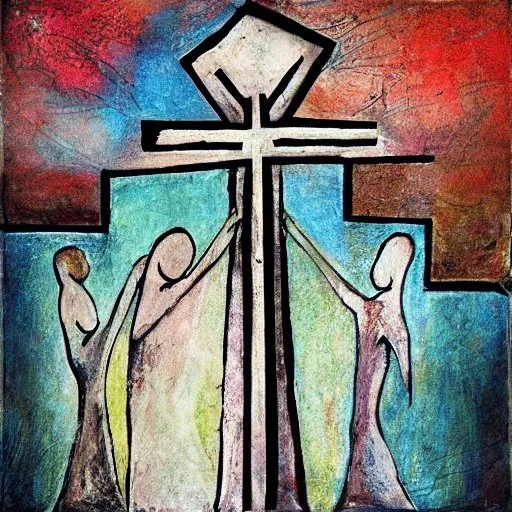
Rituals of Atonement
The Penultimate Act
Chronologically, this is the latest (and, I sincerely hope, the last) song, but in terms of the trajectory I wish to convey - and then to live - it must preceed that final song, Hommage a la Vie, which appears at the bottom of After the End.
For simply to express gratitude for the joys this life has rendered would be to ignore a painful truth - that living has entailed regrets and accrued remorse. Alas, what’s done is done, and cannot be altered. Thus the need, recognized across all times and cultures, for atonement.
The process begins with a sincere, empathetic appreciation of the suffering we’ve caused. This leads to the possibility of an improved self, one less prone to repeat his sins. But there is more: various spiritual traditions know of the ameliorative effects of a sacrifice, whereby the uneasy dead are appeased (as in the Zulu incantation here employed), or whereby the accumulated grief of the world (seen in Korean shamanism as a great knot) is loosened and unravelled, or as in the crucifixion of Jesus, in whose blood are the sins of the world washed clean.
My personal sacrifice, one of no great consequence, but necessary if I would attain a peaceful state of gratitude, is to lesson my dedication to my craft, and devote more of the time that remains to service, a decision at which I probably should haved arrived some time ago. Music, after all, will never save the world, at least so long as it takes the form of entertainment, the dim consolation of lives trapped in a cycle of vain pursuits. Perhaps, to some degree, in ancient rituals, where music was magical and central, the efficacy was real, not illusory. It is with this in mind that, toward the end of the present work, I would have the listeners - including a group of enthusiatic children - stream on to the stage and mingle with the musicians, dissolving the boundary of performer and audience, and symbolizing a spiritual breakthrough validated, I hope, by my renunciation of art, and entry into a new phase of existence. (There being no available audience, I ask the viewer to imagine one, and to imagine as well, at the end, the lead singer descending the stage and walking off into a sunset beach, climbing into a boat, and departing for parts unknown.)
As for the title, I have come full circle indeed - returning to that choice deferred fifty years ago. But musically as well, the event features a reprise, strange and serendipitous, of a couple of melodies I learned many years ago when, as part of my duties as organist at the Church of the Good Shepherd, I accompanied the “Spanish Choir” in the performance of sacred texts set to secular dance rhythms. Why, after all this time, does this vivacious music thrill me? What has its infectious joy to do with the solemnity one might expect in a ritual of atonement? Is my recent tendecy to plagiarize and to juxtapose disparate and distant musical memories a sign of supreme compositional mastery by which I rise above petty stylistic scruples, or proof of creative bankruptcy, even senitlity? Ah, but such concerns come from that fallen world I would abandon: may this music help unwind the knotted grief of the world.